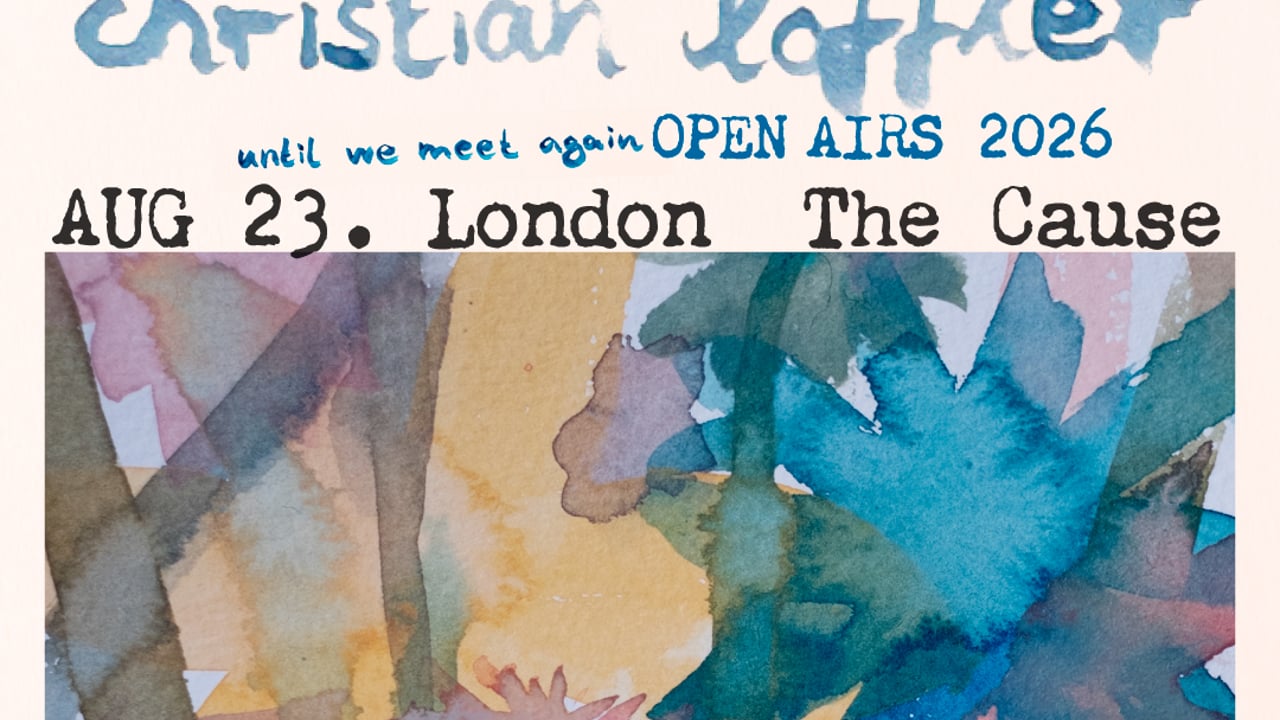
Christian Löffler @ The Cause
The Cause, 60 Dock Road, E16 1YZ London Directions
Sun 23.08.2026 14:00
Off the back of an incredible sold out show at the Barbican, German producer Christian Löffler brings his latest album Until We Meet Again to The Cause’s Courtyard, East London’s treasured DIY open air space. This will be the only chance to see him this summer in London.
Written while touring, the record centres on piano sketches and analogue synthesis, with vocals from Adna featured on select tracks. The project focuses on themes of transience and personal connection, maintaining a consistent, minimal structure throughout.
After bringing his album across some of Europe’s most famed concert halls, including the Cirque Royal in Brussels, Auditorium Ennio Morricone in Rome, and Dublin’s National Concert Hall, UWMA’s next iteration will see Löffler perform at the Cause, a warehouse complex nestled in the industrial heart of East London, overseeing the river Thames; the perfect space to enjoy his rich sonic palette.
Channeling London’s day party spirit, and taking place on Sunday 23rd August this will be a rare chance to experience one of today’s most revered melodic storytellers in an intimate space, alongside some very special guests handpicked by Christian himself.
Christian Löffler presents ‘Until We Meet Again’
Saturday 23rd August
The Cause
1pm - 10:00pm - 18+ Event
(Last Entry 8pm)
Brought to you by LWE
Performers
-
Christian Löffler
overlooking the southern coast of the Baltic Sea, is a log cabin, nestled among the jungle-like overgrowth of surrounding birch and willow trees. The cabin is Christian Loeffler's atelier, where he locks himself up to work on both his visual art
his music. In the centre of the room is a huge oak table, splotched with multicoloured oil paints, surrounded by canvases, cameras tripods, tools, brushes. There's a great view of the sea, and the wide patio windows allow the light to flood inside, casting shadows of the leaves and branches across the walls and onto the table. There's a small fireplace which allows him to work during the winter, so that he can continue his introspectiive creative process during the cold months too. The place is very basic – working, sleeping, cooking, all in one room; yet it's these modest and in some ways rudimentary parameters that allow Loeffler to make sincere and honest music, concentraing on just the essentials. 'Mare' is his second studio album and follows in a similar vein to his self-released debut, 2012's 'A Forest'. However a key difference is that while his first album was heavily sample-based, 'Mare' is much more organic, in which nearly every sound and every instrument is self-recorded. Many of the album's ideas are based on field-recordings taken from the surroundings. On top of this, several microphones were set up in the room ad left to run on for whole sessions. The microphones collected everything, from tapping, singing, playing, footsteps, as well as percussive elements added on the fly such as bottles, sticks, a set of keys, or basically anything that was lying around. Sometimes he would open the sliding patio doors, where sounds from outside would blend into the mix. Among the instruments placed around the table were an old marimba, a mandolin zither, some self-modified synthesizers, and various other sound tools accumulated from his travels. There are also four tracks that feature the vocals of previous collaborator Mohna ('Haul', 'Mare', 'Vind', 'Wilderness'). For Loeffler, another interesting aspect of the album is that it's the first time he himself sings on a record ('Lid', 'Pacific', 'Nil'). „The meaning was not intended to be essentially different to 'A Forest' but where the first album sometimes still felt to just be on the surface of what I can say with this project, it now feels like that I've come closer to the core of what I want to express.“ The instrumentation, the setting, and the process, make 'Mare' a highly individual body of work that sees him expanding the limits of his set-up. The LP features the highly emotive sound that Loeffler's become known for, using deep house as a stylistic framework with which to base his tracks. Exploring spaces of emotional and physical loss, getting lost, as well as arriving, he blends wistful melodies, drum machines, and found sound into a wandering, melancholic mélange.